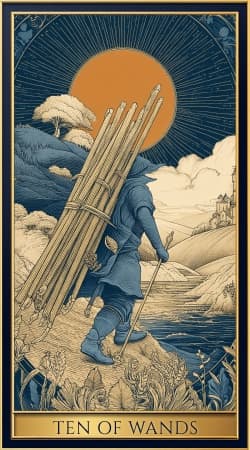
The Ten of Wands presents a solitary figure struggling under the weight of a thick bundle of ten staves, each one bound to the others. The figure’s posture is one of exhaustion, head bowed, shoulders slumped, as they trudge along a path that disappears into the distance. The staves themselves, while heavy, also represent completed tasks, responsibilities, and perhaps even accomplishments. They are not inherently negative; they are the tangible results of effort and dedication. Yet, the sheer volume of them has become a burden. This imagery speaks to the point where accumulated duties and the drive to see them through to completion can become overwhelming, overshadowing the initial purpose or satisfaction derived from the work itself. The staves are not broken, nor is the figure lying down; they are still moving forward, albeit with great difficulty, suggesting a persistence that borders on stubbornness.
When the Ten of Wands appears in a reading, it signifies a period where you are carrying a significant load, likely of your own making through commitment and hard work. It’s the moment when you feel buried under responsibilities, perhaps working harder than ever, yet close to a breakthrough or the completion of a major project. The reversed Ten of Wands indicates that this energy is not necessarily gone, but it has become distorted. It could manifest as severe burnout and exhaustion, where the sheer pressure leads to mistakes or a complete inability to continue. Alternatively, it might represent an imbalance, where the focus on this one area of intense work has led to negligence in other crucial aspects of life, or a feeling that the burden is no longer yours to bear, leading to a release that might feel like relief or irresponsibility.
This card invites contemplation on the nature of responsibility and achievement. Are you taking on too much? Is the weight you carry self-imposed, and if so, why? It asks you to examine the point where dedication crosses the line into self-neglect. Consider the path ahead: Is it one you truly want to continue walking with such heavy loads? The Ten of Wands encourages a pause, not to abandon your journey, but to reassess your carrying capacity. Before you take another step, ask yourself: What can be set down? What can be shared? What staves, if any, can be released now, so that the final stretch is manageable and perhaps even brings a sense of earned peace rather than just relief from exhaustion.