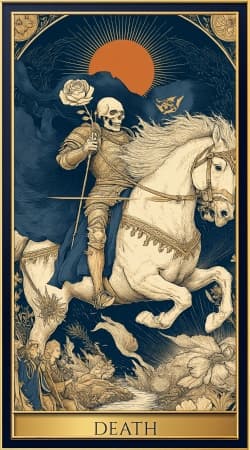
The Death card, number thirteen in the Major Arcana, is one of the most misunderstood cards in the deck. It depicts a skeletal figure, often armored and riding a white horse, carrying a banner. This figure is not the Grim Reaper as a harbinger of doom, but rather an agent of transformation. The skeleton represents the underlying, unchanging structure beneath all forms, reminding us that all physical things are temporary. The white horse symbolizes purity and the unstoppable force of change, while the banner, often bearing a mystical rose, signifies beauty and regeneration emerging even from destruction. In the background, two figures, a bishop and a woman, along with a child and a dog, react to the approaching Death. These figures represent different ways of confronting change: the bishop perhaps embodies a spiritual approach, the woman a more earthly one, and the child and dog represent innocence and loyalty, often the most vulnerable in times of transition. The sun rising between two towers in the distance hints at the dawn that follows the darkest night, suggesting that endings are not absolute but are necessary precursors to new beginnings.
When the Death card appears upright, it signifies a profound and often inevitable ending. This is not necessarily a physical death but the conclusion of a cycle, a situation, a relationship, or a way of being. It’s the necessary shedding of the old to make space for the new. The energy is one of purification and transition, clearing the path for rebirth. Reversed, the Death card suggests resistance to this natural process. Instead of embracing the inevitable change, there might be a clinging to the past, a stagnation, or an obsession with what is ending. This refusal to let go can lead to prolonged suffering or a blockage of the new energy trying to emerge. It's the same transformative force, but it's being held back, causing internal conflict and a refusal to move forward. The card in this position can also indicate that the necessary ending is being resisted so strongly that it becomes an unhealthy fixation on the past.
This card invites us to consider what in our lives has reached its natural conclusion. What are we holding onto that no longer serves us? The imagery of Death urges us to face the impermanence of all things and to find the courage to release what must pass. It asks us to look at our attachments and to question our fear of endings. Perhaps the most practical way to engage with this card is to identify one specific aspect of your life or a particular pattern of thought that you feel is finished, and to consciously begin the process of letting it go. This could be as simple as deleting old emails, unfriending someone on social media who no longer brings you joy, or making a definitive decision about a stalled project. The intention is to practice the act of release, acknowledging that endings are fertile ground for new growth.