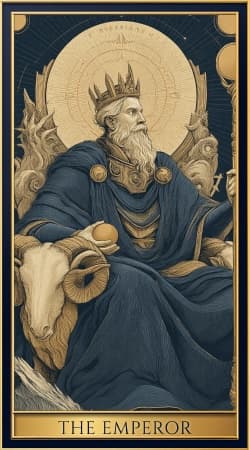
The Emperor card stands as a testament to structure, order, and the establishment of boundaries. Its central figure, a stern and imposing man, is often depicted seated upon a throne, an image that immediately communicates power and steadfastness. His scepter, a symbol of his dominion, and his orb, representing the world under his command, further emphasize his control over his domain. The throne itself is frequently adorned with ram's heads, linking the Emperor to the zodiac sign Aries and its inherent qualities of initiation, assertiveness, and masculine energy. This imagery is not about arbitrary rule, but about the conscious creation and maintenance of a stable framework, a paternalistic authority that provides security and predictability. It speaks to the father figure, the builder, the one who lays down the law and ensures it is followed, creating a world where systems and logic prevail over chaos.
When The Emperor appears in a reading, it signifies a time of solidifying your position, taking charge, or recognizing established authority. It's about the conscious application of will to create order and stability, whether in your own life or in external circumstances. The energy is one of focused control and the responsible exercise of power. Reversed, this powerful energy can become stifled or tyrannical. Instead of balanced command, it manifests as rigidity, stubbornness, or an unhealthy overemphasis on control, potentially leading to the abuse of authority or an inability to adapt. The structure becomes a prison, the order becomes oppressive, and the paternalistic figure turns domineering, lacking empathy and flexibility.
This card invites you to examine the structures in your life. What foundations are you building upon? Are they solid and sustainable, or are they cracking under pressure? The Emperor asks you to consider your own sense of authority – where do you exert it, and is it balanced with responsibility and fairness? If reversed, it challenges you to loosen your grip, to question rigid beliefs, and to ensure your control isn't becoming a source of oppression for yourself or others. Sit with the question: How can I establish or reinforce a sense of order and security in a way that is both firm and fair? Consider one area where you might be exerting too much rigid control and explore one small way to introduce flexibility.