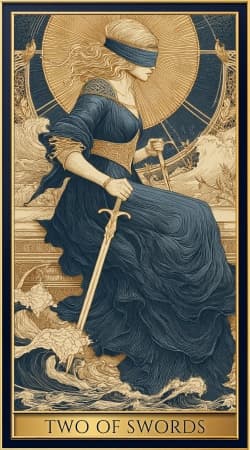
The Two of Swords presents a stark image: a blindfolded figure, usually a woman, seated with two crossed swords held before her chest. The blindfold signifies a refusal or inability to see the truth of a situation, a deliberate choice to remain unaware. The crossed swords, held firmly across the heart, represent a conflict or a difficult choice that has been halted, frozen in time. This stalemate is not necessarily a sign of weakness, but often a necessary pause. Behind the figure, a body of water often appears, perhaps a lake or the sea, suggesting deep emotions or the subconscious. A crescent moon may also be visible, hinting at intuition, the feminine, and the cyclical nature of things, yet the figure seems disconnected from these subtle influences, suspended in a state of forced neutrality. The gray cloak she wears further emphasizes this lack of engagement, a neutral zone between opposing forces.
When the Two of Swords appears in a reading, it points to a period of indecision or a situation where a choice must be made but is being actively avoided. It’s the moment before the plunge, where two paths are equally weighted, and stepping in either direction feels impossible. This isn’t about a lack of options, but often an overabundance, leading to paralysis. The upright card suggests a need for mental equilibrium, a calm assessment before action, even if that action feels daunting. Reversed, this energy can manifest as prolonged avoidance, where suppressed emotions begin to fester, or the indecision becomes so overwhelming that it threatens to erupt into a chaotic outburst. It can also indicate a confusion of senses, where the truth is obscured not by choice, but by internal chaos or external manipulation.
This card invites contemplation on the nature of choice and the cost of avoidance. It asks you to consider what truths you are unwilling to face and why. Are you waiting for external validation or a sign that will never come? The Two of Swords challenges you to acknowledge the stalemate and consider the potential consequences of remaining frozen. Perhaps the first step is simply to acknowledge the difficulty of the choice, to remove the blindfold, even if only for a moment, and peer into the abyss. What hidden assumptions are you carrying? What are you truly afraid of seeing? The usable takeaway is to recognize that even in moments of profound indecision, there is a quiet strength to be found in honest self-assessment before any external action is taken.